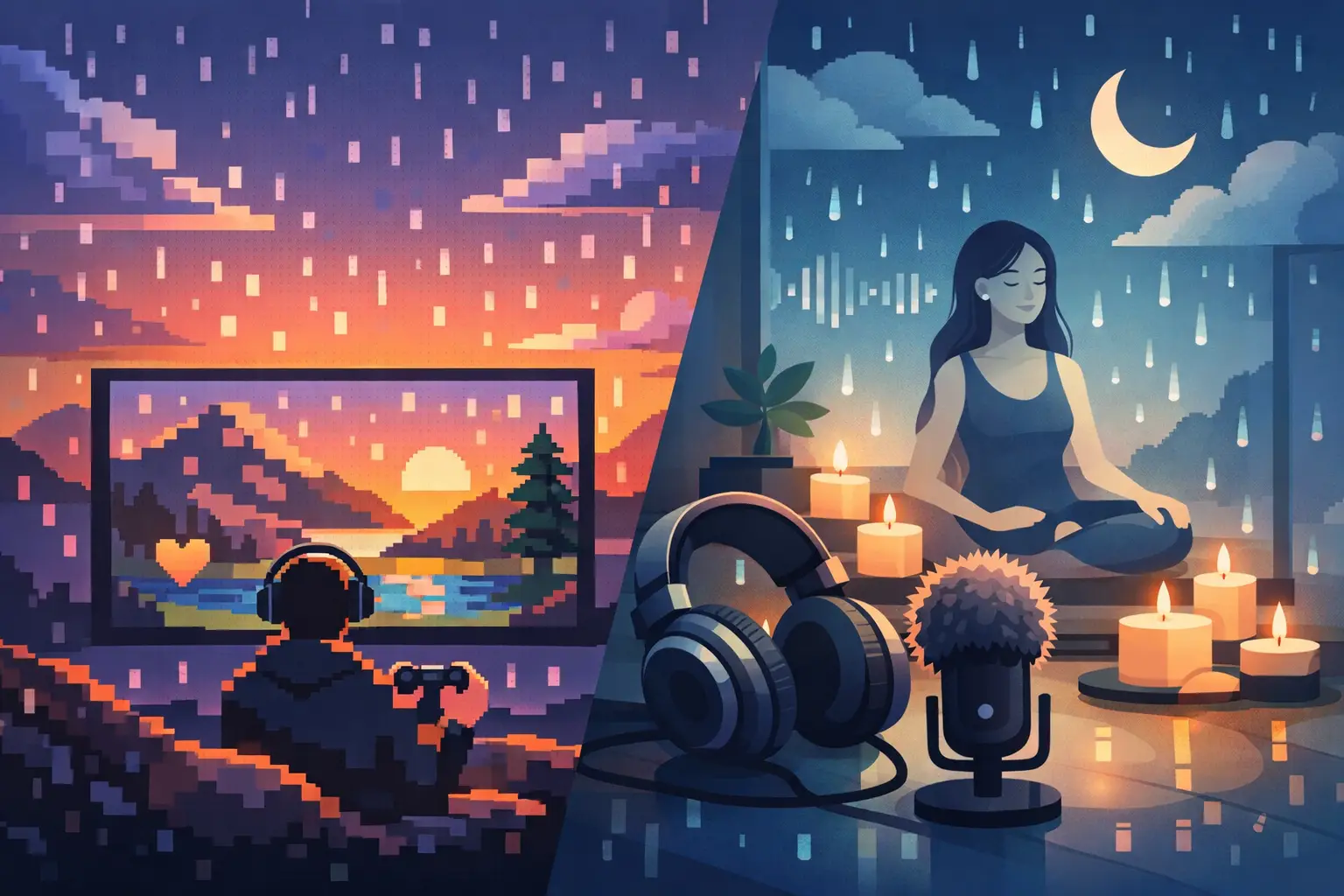
A rain video can make a busy room feel quieter. A slow-moving game can do something slightly different: give your attention a soft place to rest while offering a small sense of forward motion. That is the real choice in ambient games versus ASMR videos. Both can make a break feel gentler, but they create calm through different rhythms.
For someone who wants to decompress without another demanding task, the better option is not always the one with the most relaxing sound or the prettiest screen. It is the one that matches what your mind needs in that moment: complete passivity, a little visual satisfaction, or a simple reward for checking in.
Ambient Games Versus ASMR Videos: The Core Difference
ASMR videos are designed to be received. You press play, settle in, and let sound lead the experience. Whispers, tapping, brushing, rainfall, crinkling paper, or quiet role-play scenes can create a focused sensory atmosphere. There is no decision to make and no progress to protect. That lack of expectation is a large part of their appeal.
Ambient games are designed to be lightly inhabited. They may ask for a tap, an upgrade choice, or an occasional return to collect rewards, but the best ones do not demand fast reflexes or constant attention. Their calming effect comes from watching a small system unfold: particles drifting, a garden growing, clouds changing, or water droplets gathering and sliding down glass.
The difference is subtle but meaningful. ASMR says, "You do not need to do anything." An ambient game says, "You can do almost nothing, and still enjoy seeing something grow." For many people, that tiny amount of agency feels comforting rather than demanding.
When ASMR Videos Are the Better Reset
ASMR is especially well suited to moments when your brain has had enough choices. After a crowded workday, a long commute, or an evening of notifications, even a gentle game menu may feel like one thing too many. An ASMR video lets you step back completely.
Sound is also the center of the experience. If a particular trigger works for you, such as soft rain, keyboard sounds, page turning, or low voices, it can create an immediate sense of familiarity. Many people use ASMR as part of a bedtime routine because it asks so little from the eyes and mind. With the screen dimmed or placed aside, audio can remain present without inviting interaction.
Still, ASMR is personal. A sound that feels soothing to one listener can feel distracting or uncomfortable to another. Whispering may be relaxing, but it may also feel too intimate. Tapping can be pleasant, or it can become irritating when you are already overstimulated. The format offers enormous variety, yet finding the right creator, sound level, and trigger can take trial and error.
There is also no lasting thread between sessions unless you create one yourself. A video can calm you for twenty minutes, but when it ends, the experience is finished. That can be exactly right when you want a clean, quiet pause.
Why Ambient Games Feel Calming in a Different Way
Ambient games pair relaxation with gentle continuity. The visual scene is not merely playing in front of you. It responds over time, sometimes with almost no effort on your part. That response can make a brief check-in feel satisfying without turning it into a goal-heavy routine.
A well-made ambient game avoids the usual pressures associated with mobile gaming. It does not rush you with timers, punish you for leaving, or make every moment feel like an optimization puzzle. Instead, it uses simple progression loops to give the eye and mind a pleasant reason to return.
This matters when passive viewing alone feels a little too empty. Some people relax best when their hands have a small role to play. Choosing an upgrade, watching an idle reward arrive, or seeing a visual effect become more beautiful can provide a calm sense of completion. It is entertainment with a lower emotional volume.
The visual layer can be especially powerful. Realistic movement, soft lighting, and slow physics give the brain something gentle to follow. In Droplet Idle, for example, droplets form, merge, and glide across the screen in a soothing rhythm, while quiet upgrades and passive rewards add structure beneath the rain-on-a-window feeling. The progression is there when you want it, not when you need to prove anything.
Passive Does Not Always Mean Better
It is tempting to assume that the least interactive option is automatically the most relaxing. Sometimes it is. But calm is not the same as inactivity.
If you are ruminating, completely passive content can leave too much room for your thoughts to circle. A light ambient game may help because it gives your attention a soft anchor. You are not solving a difficult problem, but you are noticing movement, collecting a reward, and making one small choice. That can be enough to interrupt mental noise.
On the other hand, if you are exhausted or trying to fall asleep, a game may be more engaging than you need. Even gentle progression can make you want to check one more upgrade or wait for one more reward. ASMR, instrumental audio, or a simple rain recording may be the better companion when the goal is to drift off rather than stay pleasantly occupied.
Screen use is another trade-off. Both formats often live on a phone, and bright screens can work against an evening wind-down routine. Lowering brightness, using a warm display setting, and setting a short session limit can help. If sound is the main benefit you want, ASMR can also continue with the screen facedown or turned off, depending on your device and app settings.
Choose by the Kind of Break You Need
The easiest way to choose between ambient games and ASMR videos is to notice what your nervous system is asking for.
Choose ASMR when you want to be carried by sound, when decision fatigue is high, or when you are settling into rest. It is a good fit for quiet reading, stretching, bedtime, or simply sitting still after a noisy day.
Choose an ambient game when you want visual comfort with a little more presence. It fits a short afternoon pause, a waiting room, a work break, or the few minutes when you want to look at something beautiful without committing to a show, a social feed, or a competitive game.
You do not have to pick one permanently. Many calming routines use both. An ambient game can offer a satisfying five-minute reset between tasks, while ASMR can take over later when the day is ready to soften. The goal is not to optimize relaxation. It is to make room for it.
What to Look for in a Calming Digital Experience
The most restorative option usually has a low barrier to entry and a low emotional cost. Look for visuals or sounds you genuinely enjoy, not ones that simply seem popular. A calming experience should feel easy to return to, easy to leave, and free from the fear of missing out.
For ambient games, that often means slow pacing, clear mechanics, offline rewards, and an atmosphere that stays pleasant even when you are not actively tapping. Avoid games that hide pressure behind relaxing artwork, such as aggressive pop-ups, constant limited-time events, or systems that make absence feel like failure.
For ASMR, pay attention to whether the creator's style relaxes you consistently. A simple soundscape may work better than an elaborate production. You may prefer rainfall and soft room tone over close-up triggers, or gentle tapping over voices. There is no universal best sound, only the one that lets your shoulders drop.
A calmer screen habit does not need to be perfect or productive. It can be as simple as a few minutes watching droplets collect on virtual glass, or letting soft rain play while the room grows quiet.