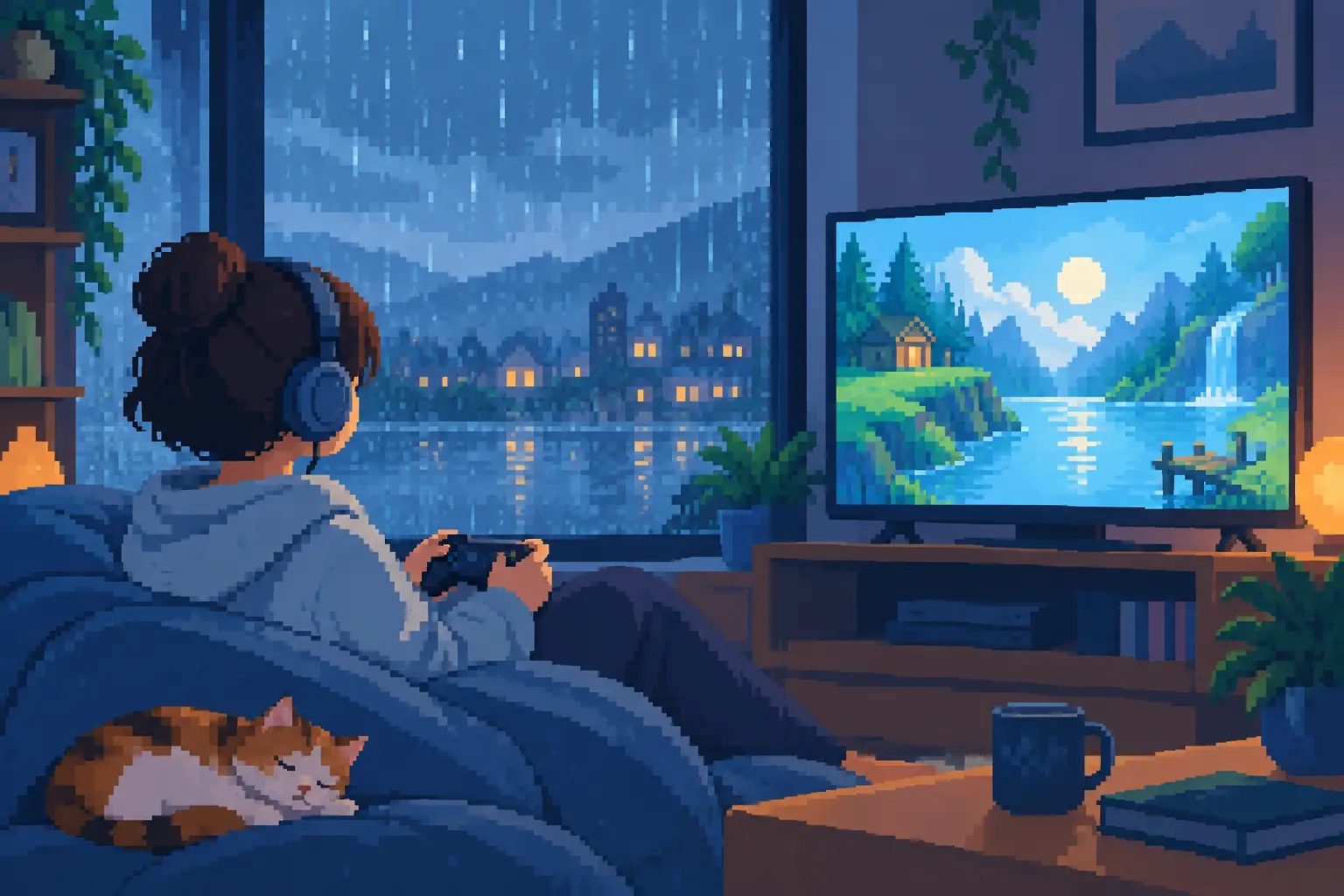
A screen can become a small, quiet place to rest your attention. The best games for visual stimming offer pleasing motion, gentle repetition, and enough interaction to feel satisfying without asking you to stay alert, react quickly, or compete. Think droplets gathering on glass, colors falling into place, tiny worlds growing at their own pace, or a familiar pattern looping exactly as expected.
Visual stimming is personal. What feels calming to one person may feel distracting, too bright, or too busy to someone else. The goal is not to find one perfect game for everyone. It is to notice the kinds of movement, color, pace, and control that help you feel settled - then choose a game that gives you more of them.
What makes a game good for visual stimming?
The most soothing games tend to make their visual pleasure easy to return to. They do not punish you for looking away, demand split-second timing, or fill every moment with flashing alerts. Instead, they create a steady visual rhythm: objects merge, drift, bloom, stack, sparkle, or move across the screen in a predictable way.
Control matters, too. Some people prefer passive visuals they can watch without doing much. Others relax more when they can gently guide the movement with a tap, swipe, or slow drag. A good fit gives you a feeling of choice without turning that choice into pressure.
Look for adjustable sound, an optional low-stimulation mode, and an interface that does not bury the screen beneath timers, pop-ups, or advertisements. A beautiful visual loop can lose its comfort quickly when it is interrupted every few seconds.
12 best games for visual stimming
1. Droplet Idle
Watching rain collect and move across a window has a naturally soothing rhythm. In Droplet Idle, droplets form, merge into larger beads, and slide down the screen with realistic physics, soft bokeh lighting, and smooth 60 FPS animation. There is a quiet satisfaction in seeing small drops gather into a larger stream.
The idle progression gives the experience gentle structure. Upgrades, offline rewards, and prestige add something to return to, while the visual centerpiece remains calm enough to enjoy during a short break or while winding down at night.
2. I Love Hue Too
This color-arranging puzzle is ideal for people who find gradients especially satisfying. You move colored tiles until they form a smooth transition from one shade to the next. The completed board has a calm, ordered look, and each small adjustment creates visible progress.
It is less about speed than visual harmony. That makes it a good choice when you want a focused activity with no rushing and a clear, pleasing result.
3. Fluid simulation apps and games
Interactive fluid simulations let you touch the screen and watch ink, smoke, light, or liquid respond. The effect can be mesmerizing: color curls outward, eddies form, and each movement creates a new pattern that disappears slowly into the next.
These experiences are often more sensory than game-like, which can be a benefit. If goals, scores, and progression feel like extra noise, a fluid simulation offers pure visual interaction. The trade-off is that it may not hold your attention as long as a game with light structure.
4. Tetris Effect: Connected
For some players, falling blocks create a comforting visual rhythm. Tetris Effect: Connected elevates that rhythm with glowing particles, shifting backgrounds, and music that responds to your play. Clearing lines provides a clean visual reset, while the repeated shapes make each move easy to understand.
Still, it is not a low-demand option for everyone. The pace increases and can become intense. It works best if you enjoy structured repetition and find fast-moving patterns energizing rather than overwhelming.
5. Alto's Odyssey
Alto's Odyssey is built around smooth motion. You guide a character across rolling dunes, through soft light, changing weather, and distant landscapes. The continuous forward movement can feel almost hypnotic, especially when you are simply gliding instead of trying to perfect every jump.
It has goals and challenges, but the visual flow is the real draw. Turning off sound effects or playing with low volume can make it feel even more like a peaceful moving wallpaper with a little input from you.
6. Prune
Prune is a gentle puzzle about shaping a growing tree toward sunlight. With a swipe, you trim branches and watch the tree respond. The motion is simple, organic, and unhurried, with clean backgrounds that leave plenty of visual breathing room.
Its minimalist style is especially helpful if busy scenes are tiring. Rather than adding more objects to the screen, each level asks you to create a graceful form with less.
7. Monument Valley
The shifting architecture in Monument Valley offers a different kind of visual satisfaction. You rotate and move impossible structures until paths connect in unexpected ways. Soft colors, deliberate animation, and uncluttered scenes make each completed movement feel like a tiny visual reveal.
This is a better fit for someone who likes visual stimming paired with a light puzzle. It asks for more thought than an idle game or simulation, but it remains far gentler than most challenge-driven mobile games.
8. A Little to the Left
There is a particular comfort in putting small things in order. A Little to the Left turns that impulse into warm, tactile puzzles: arranging books, aligning stationery, sorting objects, and finding patterns in ordinary items.
The appeal comes from visual completion. A slightly messy scene becomes balanced, and the game rewards you with a clean arrangement. If symmetry, sorting, and tidy grids feel satisfying, it can provide a reassuring reset between larger tasks.
9. Viridi
Viridi lets you care for a small pot of succulents that grows in real time. Its appeal is slow and quiet. You can water plants, remove a stray weed, and check back later to see subtle changes.
Because there is so little urgency, it works well as a background ritual. It will not provide constant movement for players seeking stronger visual stimulation, but its tiny details can be deeply comforting for those who prefer stillness with occasional change.
10. My Little Universe
Watching a bare space fill with color and resources can be very rewarding. My Little Universe uses simple gathering loops to turn small islands into fuller, brighter worlds. Trees, rocks, paths, and structures appear as you collect materials, creating a steady sense of visual expansion.
The loop is easy to understand and gives your hands something repetitive to do. Be aware that resource collection can become more task-oriented than purely relaxing, so it is best for times when you want calm progress rather than complete passivity.
11. Unpacking
Unpacking transforms everyday objects into a quiet visual story. You remove items from boxes and place them around rooms, finding the spot where each one feels right. There are no enemies, no countdowns, and no need for fast reactions.
The visual pleasure comes from gradual organization. Empty shelves become lived-in spaces, and each room settles into a more complete shape. It is a lovely choice for people who enjoy categorizing, arranging, and seeing disorder resolve.
12. Zen Koi 2
Zen Koi 2 centers on colorful fish moving through tranquil water. You guide a koi toward smaller creatures, collect patterns, and watch your fish grow and evolve. The tail movement, glowing colors, and circular swimming paths create a soft, repeatable visual loop.
It offers more active play than a passive ambient experience, yet its pace remains forgiving. If you enjoy watching graceful movement with a little collecting and progression, it can be a peaceful fit.
How to choose the right visual rhythm
Start with the movement you naturally want to watch. Flowing motion, such as water, smoke, and drifting landscapes, can feel soothing when you need to soften your focus. Repeating geometric movement, such as falling blocks or matching tiles, may feel better when you want your attention to settle into a clear pattern.
Then consider your energy level. A puzzle with an endpoint can be satisfying during a lunch break, while an idle game, aquarium, or fluid simulation may be better when your brain is already full. Neither choice is more valid. The right game is the one that feels restorative rather than demanding.
Brightness and sound are also worth adjusting before deciding a game is not for you. Lowering screen brightness, muting sharp effects, or choosing a quieter time of day can change the entire experience. If a game begins to feel tense, repetitive in the wrong way, or visually crowded, step away without trying to push through it.
Let the screen feel lighter
The best visual stimming game is not necessarily the most beautiful or the most popular. It is the one whose movement gives your eyes somewhere pleasant to land. Keep a few different options for different moods, and let your choice be simple: a little color, a little motion, and a few quiet minutes that ask nothing more from you.