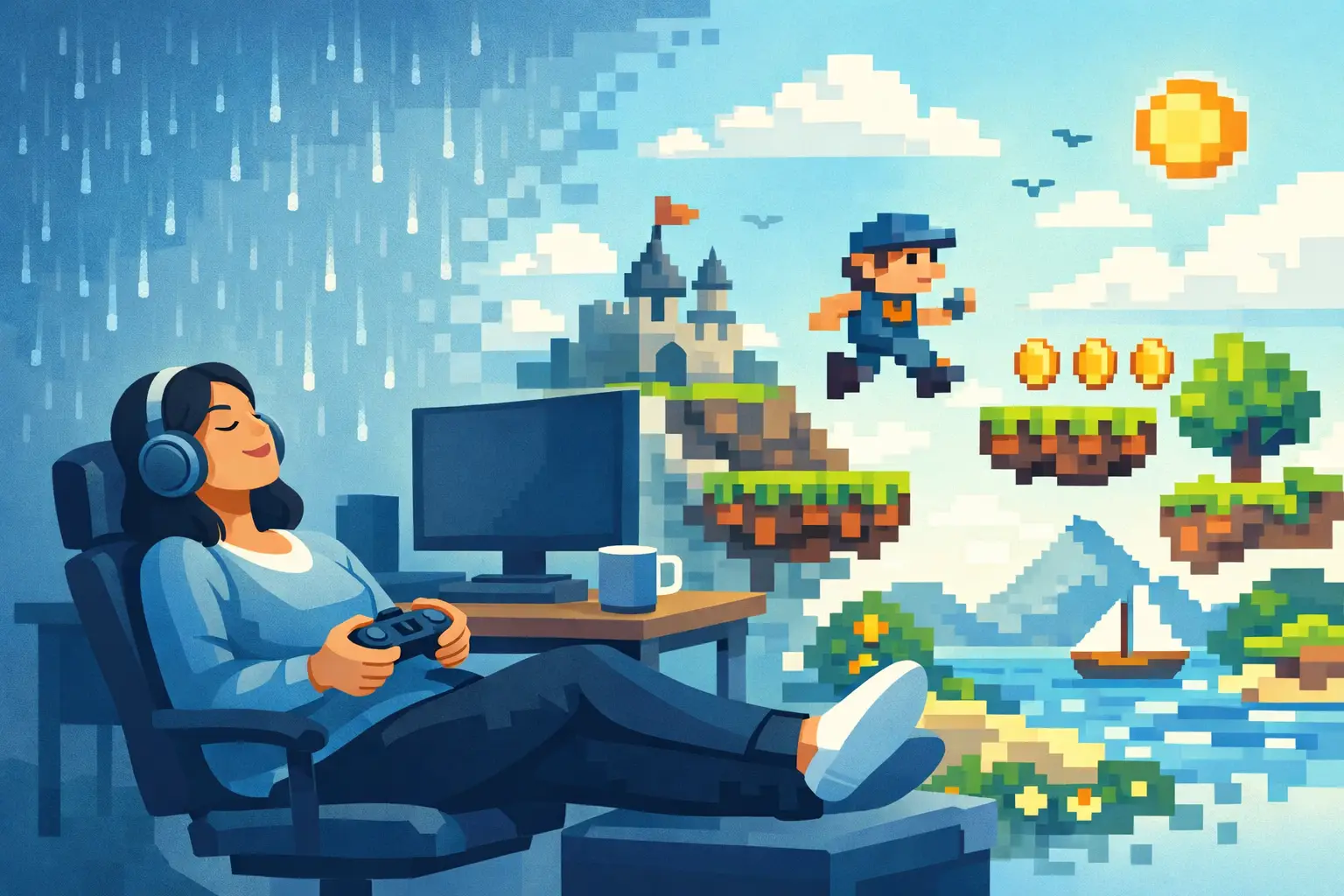
The most restorative game session may not be the one where you win. It may be the ten quiet minutes after a crowded commute, with your phone in hand, watching soft movement on a screen while your attention has nowhere urgent to go. Learning how to use games for decompression starts with choosing experiences that ask for less from you, not more.
Games can offer a welcome pocket of pleasure, color, rhythm, and small accomplishment. But not every game creates the same feeling. A competitive match, a ticking event timer, or a screen full of daily tasks can turn a break into another source of pressure. For decompression, the goal is simple: choose play that gives your mind room to settle.
Why low-pressure games can feel so restorative
After a long day, your attention may already be stretched thin. You have made decisions, answered messages, managed plans, and moved from one demand to the next. A game with complicated controls or high stakes can be enjoyable at the right time, but it may require the exact kind of energy you are trying to set down.
Gentle games work differently. They give you a clear, contained activity with immediate feedback: tap, watch, collect, upgrade, return later. That simple loop can feel pleasantly grounding because there is no need to perform for anyone, react quickly, or get everything right.
Sensory design matters, too. A satisfying animation, quiet palette, smooth motion, or comforting soundscape can make a short play session feel more like a pause than a challenge. Think of the calm focus of watching rain slide down a window. Nothing needs to be solved. You simply have something beautiful to notice.
This does not mean games replace sleep, movement, time outdoors, or support when stress feels overwhelming. They are one small tool for shifting gears. Used thoughtfully, they can help create a gentle boundary between the demands of the day and whatever comes next.
How to use games for decompression intentionally
The difference between relaxing play and draining play is often less about the device and more about the conditions you create around it. A decompression game should feel easy to begin and easy to leave behind.
Match the game to your energy level
Ask one quiet question before opening a game: do I want stimulation, distraction, or softness?
If you feel restless and need a quick redirect, a simple puzzle or short arcade round may help. If your thoughts are busy and you want a softer landing, choose an idle, ambient, or low-stakes game. These games let you engage lightly while the visuals and progression carry some of the experience for you.
There is no universal “best” relaxing genre. Some people unwind by organizing a cozy virtual space. Others enjoy repetitive farming, gentle exploration, or watching numbers gradually grow. The useful choice is the one that fits your current energy without asking you to fight against it.
Choose progress without urgency
Progress is satisfying. Seeing a collection grow, earning an upgrade, or returning to a new reward gives a game a pleasant sense of momentum. The problem begins when progress is tied to fear of missing out.
For decompression, favor games that allow you to step away without losing ground. Offline rewards, relaxed upgrade paths, and open-ended goals are especially helpful because they make returning feel like a welcome bonus rather than an obligation. You should be able to close the app and feel finished, even if the game continues to offer more later.
A calming idle game can be particularly well suited to this rhythm. In Droplet Idle, realistic droplets form, merge, and glide across a softly lit screen while progress unfolds at an unhurried pace. The appeal is not just what you earn. It is the soothing rhythm of having something gentle to watch.
Give the session a small shape
A game break does not need to be long to feel meaningful. In fact, a defined window can make it more relaxing because you are not negotiating with yourself about when to stop.
Try pairing low-pressure play with a natural transition: after work, while waiting for dinner, during a train ride, or before your evening routine. Ten to fifteen minutes is enough time to enjoy the visual satisfaction and small rewards without letting the session drift into late-night scrolling.
It helps to decide what “done” looks like before you start. Maybe you collect your offline rewards, choose one upgrade, and watch a few moments of ambient animation. That is a complete session. You do not need to clear every notification or reach a new milestone to earn your break.
Build a calmer game environment
The atmosphere around a game can change the experience as much as the game itself. Bright alerts, incoming messages, and five other open apps can make even peaceful play feel scattered.
Put your phone on Do Not Disturb for a few minutes when possible. Lower the screen brightness at night. If a game includes sound, try it at a comfortable volume or pair it with headphones when you want a more private, immersive moment. Small adjustments can make the screen feel less like an extension of your to-do list.
It can also help to keep one or two designated comfort games rather than downloading a constant stream of new titles. Familiarity is part of the appeal. When you already understand the loop, you can settle into it quickly instead of spending your break learning systems, comparing builds, or deciding what to do next.
Notice the signs a game is adding pressure
Even a beautiful game can stop feeling restorative if its design or your habits make it hard to step away. The clue is usually how you feel afterward.
If you regularly finish a session irritated, tense, guilty, or compelled to keep checking for timers, that game may be better suited to a different mood. Competitive games and deep strategy games are not bad choices. They can be exciting, social, and rewarding. They are simply not always the right fit when your nervous system is asking for quiet.
Watch for games that rely heavily on streaks, limited events, social comparison, or frequent prompts to spend. These mechanics can create urgency even when the artwork is cozy. A decompression game should leave you with a sense of enoughness: enough progress, enough enjoyment, enough for now.
If you find yourself playing longer than intended, use a gentle boundary rather than a harsh rule. Set a timer, finish after one upgrade cycle, or place your phone across the room when you are done. The point is not perfect discipline. It is protecting the restful quality you came for.
Let play be a transition, not an escape hatch
Games are most helpful for decompression when they become part of a wider wind-down ritual. A few calm minutes of play can lead naturally into making tea, taking a shower, stretching, reading, or simply sitting without another demand arriving immediately.
Try noticing what happens in the minute after you close the game. Does your breathing feel less hurried? Do your thoughts feel a little less crowded? Are you more ready to move into the next part of your evening? Those small shifts are more valuable than any in-game score.
There will be days when you want a lively challenge, and days when even light play is not what you need. Let your mood guide the choice. The best decompression game is not the one that holds your attention longest. It is the one that gives some of it back to you.