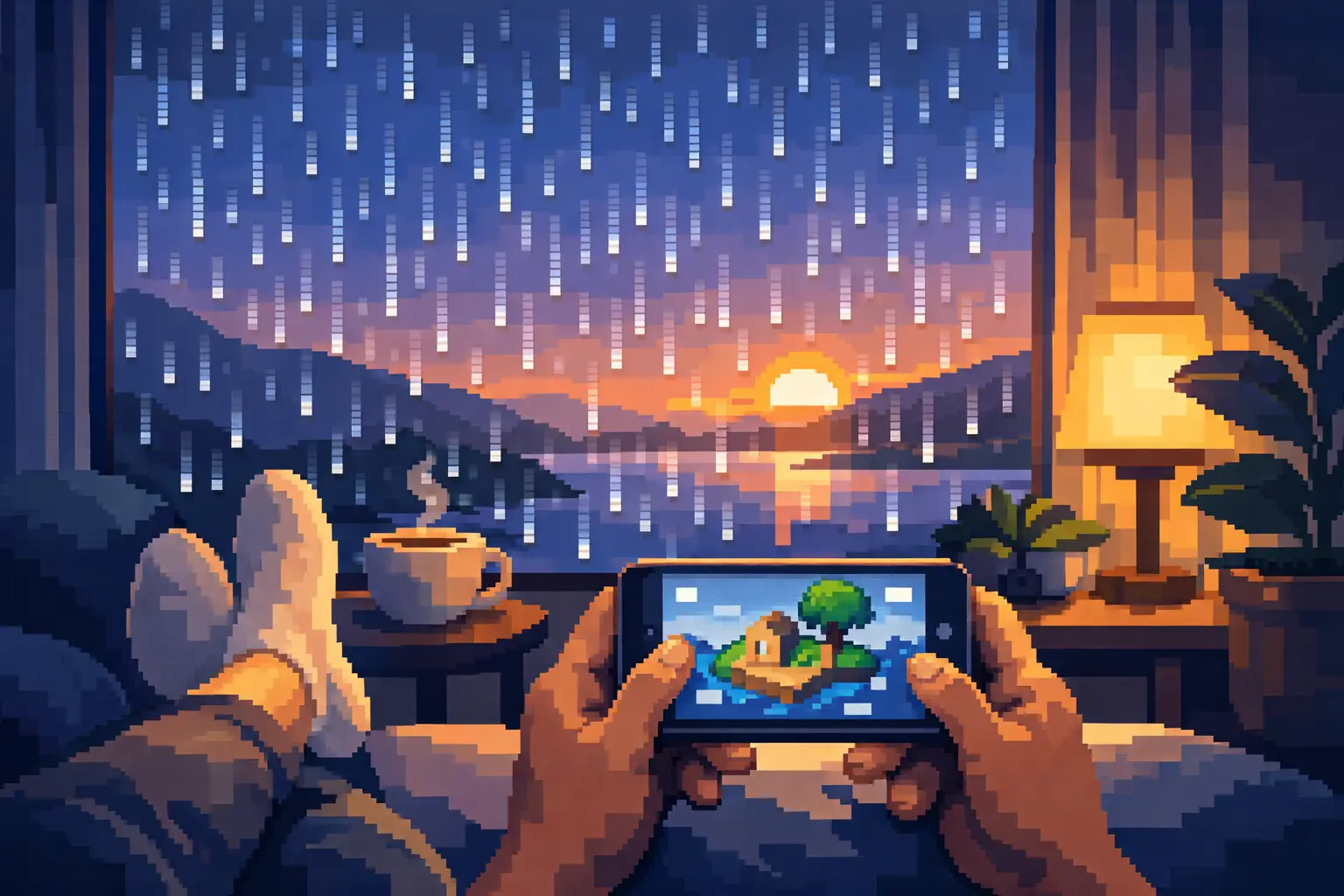
The hour before bed can feel strangely crowded. Notifications still glow, tomorrow’s tasks begin arranging themselves in your head, and even a favorite game can ask for more focus than you have left. An idle game for evening wind down should do the opposite: give your attention somewhere soft to land, with enough gentle reward to feel satisfying and none of the pressure to keep performing.
That is the appeal of a calmer kind of idle play. You can watch a small world change, make an upgrade when it feels right, then simply let the game continue at its own unhurried pace. For many players, this creates a more comforting transition between a busy day and a quieter night than fast rounds, rankings, timers, or complicated goals.
What an evening game should feel like
Not every casual game is relaxing after dark. Some are easy to start but quickly fill the screen with limited-time offers, flashing objectives, daily streaks, and choices that feel costly if you get them wrong. Others ask for quick reactions just when your mind is trying to slow down.
A good wind-down game has a different rhythm. It is pleasant to look at without demanding constant attention. Its next step is clear, but it does not punish you for waiting. You can pick it up for two minutes while brushing your teeth or let it sit beside you as part of a slower bedtime routine.
The ideal balance depends on what helps you relax. Some people want almost no interaction at all. Others enjoy a light sense of movement - a number rising, an upgrade becoming available, a new layer of progression appearing over time. The key is that progress feels like an invitation, not an obligation.
Why an idle game for evening wind down can help
Idle games are built around a simple pleasure: growth that continues without constant tapping. Resources accumulate, systems become more efficient, and returning later brings a small, reassuring reward. In a busy day, that loop can feel like one more thing to optimize. In the evening, when designed gently, it can become a quiet ritual.
There is comfort in opening a game and seeing that something has moved forward while you were away. It asks nothing about how productive you were. It does not require a perfect score. It simply gives you a small moment of visible progress.
Ambient visuals deepen that feeling. Rain on a window has long been associated with stillness: droplets gather, merge, and trace their own paths downward while the world beyond the glass grows softer. When that motion is rendered with realistic physics, dreamy bokeh light, and smooth 60 FPS animation, watching becomes part of the experience rather than a pause between menus.
That sensory focus matters. A calming idle game does not need to hold your attention through urgency. It can hold it through a soothing rhythm - the quiet anticipation of two droplets meeting, the shine of light behind the glass, the steady accumulation of rewards. Your eyes have something gentle to follow while your thoughts begin to loosen their grip.
Gentle progression still gives the night shape
Relaxation does not mean emptiness. A game with no sense of change can become background noise, while a game with too many systems becomes a project. The satisfying middle is lightweight progression: upgrades that are easy to understand, rewards that arrive naturally, and longer-term goals that remain available without looming over the session.
This is where idle mechanics fit especially well. You might improve how quickly droplets form, increase the value of each merge, or invest in an upgrade that makes future progress smoother. Each decision offers a small spark of agency, but none needs a spreadsheet or a guide.
Offline rewards are especially suited to an evening routine. They acknowledge time away from the screen instead of treating it as a loss. Open the game after dinner, collect what has accumulated, make one or two thoughtful choices, and leave knowing the next return will hold another small reward.
Prestige systems can also be calming when they are framed with care. Starting a new cycle should feel like settling into a deeper layer of the same soothing experience, not erasing hard work. The best version of prestige gives a lasting boost and a renewed sense of possibility while preserving the low-pressure pace that made the game relaxing in the first place.
Build a wind-down ritual, not another habit to maintain
The difference between a restorative nightly game and a draining one often comes down to boundaries. An idle game works beautifully as a transition activity when it has a natural stopping point. You check in, enjoy the visuals, collect a reward, perhaps choose an upgrade, and then put your phone down.
Try pairing play with something already quiet: a cup of caffeine-free tea, a few minutes under a blanket, or the moment after you set your alarm. Keep the session short enough that it feels like a release from the day, not a delay before sleep.
It also helps to lower the game’s sensory intensity. Softer screen brightness, reduced notification noise, and a comfortable volume can make a meaningful difference. If a game relies on startling sound effects, frantic music, or bright reward bursts, it may work better as daytime entertainment than as part of your evening routine.
There is one trade-off worth recognizing. Phone use close to bedtime does not suit everyone, especially if a bright screen makes it harder to drift off. If that is true for you, enjoy a few minutes earlier in the evening, turn down brightness, or treat the game as a post-dinner pause rather than the final thing you see before sleep. The goal is not to create a perfect ritual. It is to find a gentler off-ramp from the day.
Choose calm over compulsion
When looking for an idle game for evening wind down, pay attention to how it makes you feel after ten minutes. Do you feel settled, or are you checking timers? Are the menus simple enough to understand when you are tired? Does the visual design leave room for your mind to rest, or does every corner of the screen compete for attention?
Look for a game that respects pauses. It should not make you feel behind because you missed an event, lost a streak, or chose not to watch every resource counter. Gentle passive rewards and clear upgrades are more valuable at night than endless alerts about what you might miss.
Droplet Idle is built around that quieter approach. Its rain-window world turns the familiar idle loop into a visual moment of calm, where droplets form, merge, and glide through soft light while progression continues in the background. There is still something to build, upgrade, and return to - just without the feeling that your evening has become another competition.
A quiet game will not solve every stressful day, and it does not need to. Sometimes a few minutes of slow-moving water, soft light, and effortless progress are enough to tell your mind that it can stop rushing now. Let the last small reward of the day be a moment that asks you to do less.