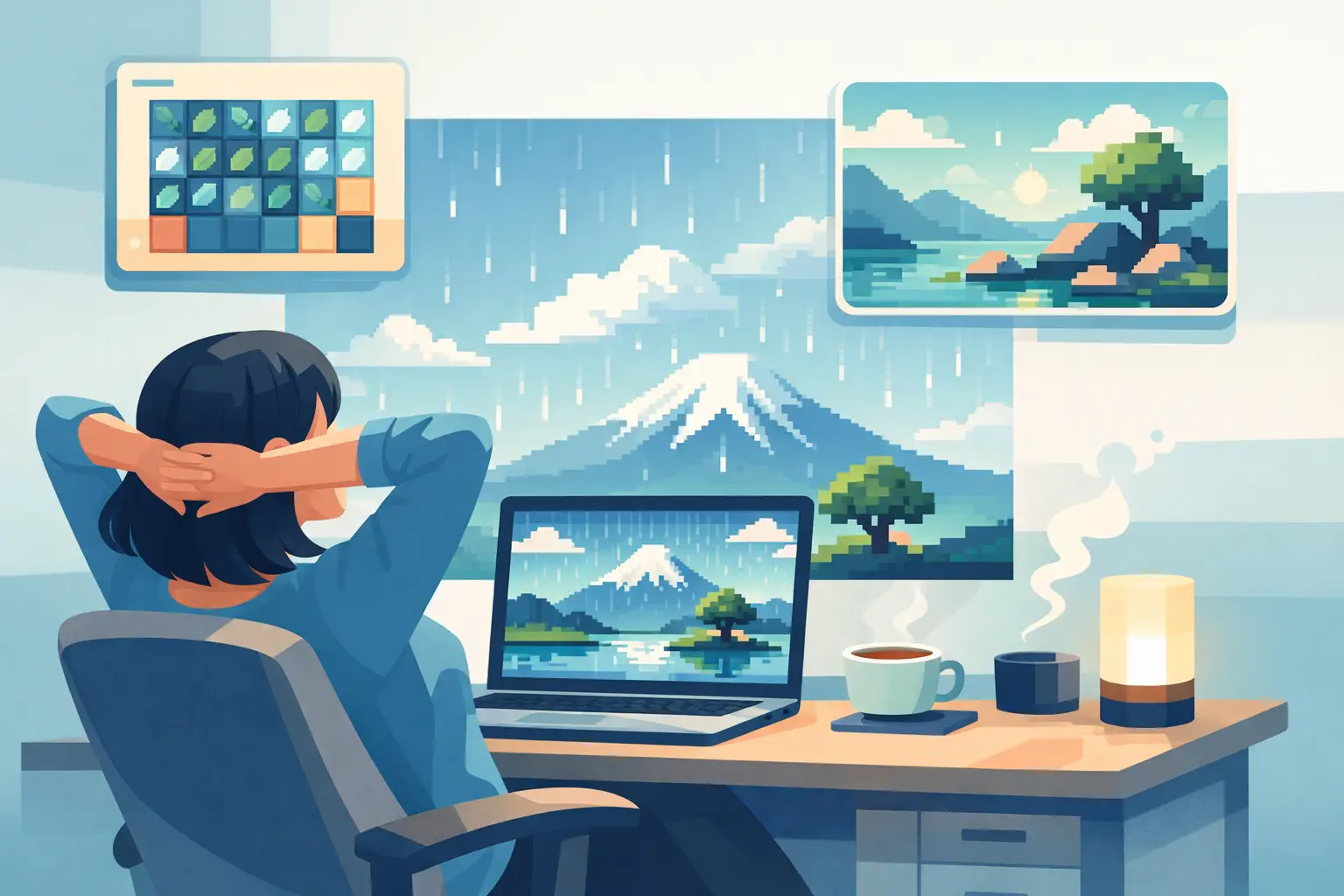
A few quiet minutes can feel surprisingly hard to find. When your attention has been pulled in every direction, a game filled with timers, battles, and alerts can add more noise instead of offering relief. Visual relaxation games take a different path: they give your eyes something beautiful to follow, your hands something simple to do, and your mind room to settle.
The appeal is not about winning quickly or proving skill. It is about watching a pleasing rhythm unfold. A raindrop gathers on glass. Light softens in the background. A small reward appears without demanding an immediate decision. That combination can turn a short break, a commute, or the final minutes before bed into a gentler moment.
What Makes Visual Relaxation Games Feel Different?
Most games are designed around urgency. They ask you to react, compete, optimize, or return before an event ends. Those systems can be exciting, but they are not always what you want when your brain is already full.
Visual relaxation games place the sensory experience first. Their movement tends to be smooth and readable rather than frantic. Their colors, lighting, and sound are chosen to create atmosphere instead of stimulation. Progress still matters, especially for players who enjoy idle games, but it arrives with less pressure.
A satisfying relaxing game usually balances three elements: visual motion that is pleasant to watch, interaction that feels effortless, and progression that gives each return visit a small sense of reward. Remove progression entirely and the experience may feel like a screen saver. Add too many systems and it stops feeling restful. The best designs sit comfortably between those two extremes.
Gentle motion gives the mind one place to rest
Our eyes naturally follow movement. When that motion is harsh or unpredictable, it can keep the body alert. When it is slow, fluid, and consistent, it can become a quiet point of focus.
Think of watching rain trace a path down a window, waves reach the shore, or clouds shift across a bright sky. These moments have no deadline. You can watch closely, glance away, or let them sit in the background. That same freedom is central to a calming game experience.
Realistic physics can make this effect even more satisfying. When droplets form, merge, stretch, and slide naturally, every movement feels connected. At 60 FPS, that movement becomes especially smooth, creating a soft visual rhythm rather than a sequence of abrupt animations.
Beauty is part of the gameplay
In a visual-first game, the background is not decoration. It is part of the reason to open the app. Dreamy bokeh lighting, soft reflections, and carefully paced animation can create a small pocket of atmosphere wherever you are.
This matters because relaxing does not always mean doing nothing. Many people want a light activity to occupy the restless edge of their attention while they decompress. A beautiful idle game can provide that activity without filling every second with instructions.
The right visual style depends on personal taste. Some players prefer cozy rain and warm window light. Others respond better to gardens, aquarium scenes, abstract patterns, or peaceful space imagery. What matters is that the visual language feels inviting, not demanding.
How Idle Progress Supports a Stress-Free Experience
A relaxing game does not need to be empty. For many players, a little structure makes the calming moment more rewarding. Idle progression gives you a reason to return while respecting the fact that you may only have a few minutes.
You might collect resources as time passes, spend them on a meaningful upgrade, and later return to see the quiet results of that choice. The loop is simple, but it creates a comforting sense of momentum. Something is growing without requiring you to constantly manage it.
That is where the idle format fits visual relaxation especially well. Passive rewards make breaks feel worthwhile, while upgrades offer a touch of agency. You are not just observing a scene. You are shaping it at an easy pace.
Prestige mechanics can also work beautifully when they are framed as a fresh, gentle cycle rather than a reset you are forced to make. A good prestige system lets players trade short-term progress for a stronger, more satisfying return. The decision should feel clear and optional, never like punishment for stepping away.
When progression becomes too much
Not every idle game is calming. A long list of currencies, limited-time events, pop-up offers, and daily obligations can turn passive play into another task on the list. More features do not automatically create more enjoyment.
If you are choosing a game for relaxation, look for progression you can understand at a glance. A few upgrades with visible effects are often more satisfying than a crowded menu of systems. It should feel good to check in after an hour, but also perfectly fine to leave the game alone for a day.
The same goes for notifications. A soothing experience should invite you back, not tug at you. The game should fit around your routine, whether that means a two-minute coffee break or a longer evening wind-down.
Choosing Visual Relaxation Games That Match Your Mood
The best choice depends on the kind of calm you need. If your mind is tired after work, you may want nearly passive play with soft animations and minimal decisions. If you feel restless, a gentle upgrade loop can provide just enough focus to keep you engaged without raising the stakes.
Before downloading or settling into a new game, pay attention to how it makes you feel in the first few minutes. Is the screen crowded? Does the soundtrack help, or does it compete for your attention? Can you understand what to do without a tutorial that feels like homework?
It is also worth noticing whether the game looks pleasant when you are not actively playing. Some of the most comforting experiences work almost like ambient companions. You can let the motion continue while you stretch, make tea, or take a breath between tasks.
For evening play, dimmer visuals and slower pacing may feel best. During a busy afternoon, brighter scenes and a few quick rewards can offer a refreshing pause. There is no single correct way to relax. The useful game is the one that meets your energy level rather than asking you to match its pace.
A Calming Ritual You Can Actually Keep
Relaxation becomes more effective when it is easy to repeat. You do not need a perfect routine or a full hour of free time. Even a short, familiar ritual can help mark the transition between tasks.
Try opening a visual relaxation game after you close your work tabs, while you wait for dinner, or when you first get into bed. Let the animation play for a few minutes before you make any upgrades. Notice the movement, the light, and the small changes on screen. There is no need to turn it into a mindfulness exercise if that feels forced. Simply giving your attention one calm place to land is enough.
Droplet Idle is built around that kind of quiet return. Watching realistic droplets gather and glide across a softly lit screen offers visual satisfaction, while passive rewards and upgrades keep the experience pleasantly alive. You can check in briefly, enjoy the progress, and leave without feeling behind.
The most restorative games are not the ones that keep you thinking about them after you close the app. They are the ones that help you put the rest of the day down for a moment, then return to it feeling a little lighter.