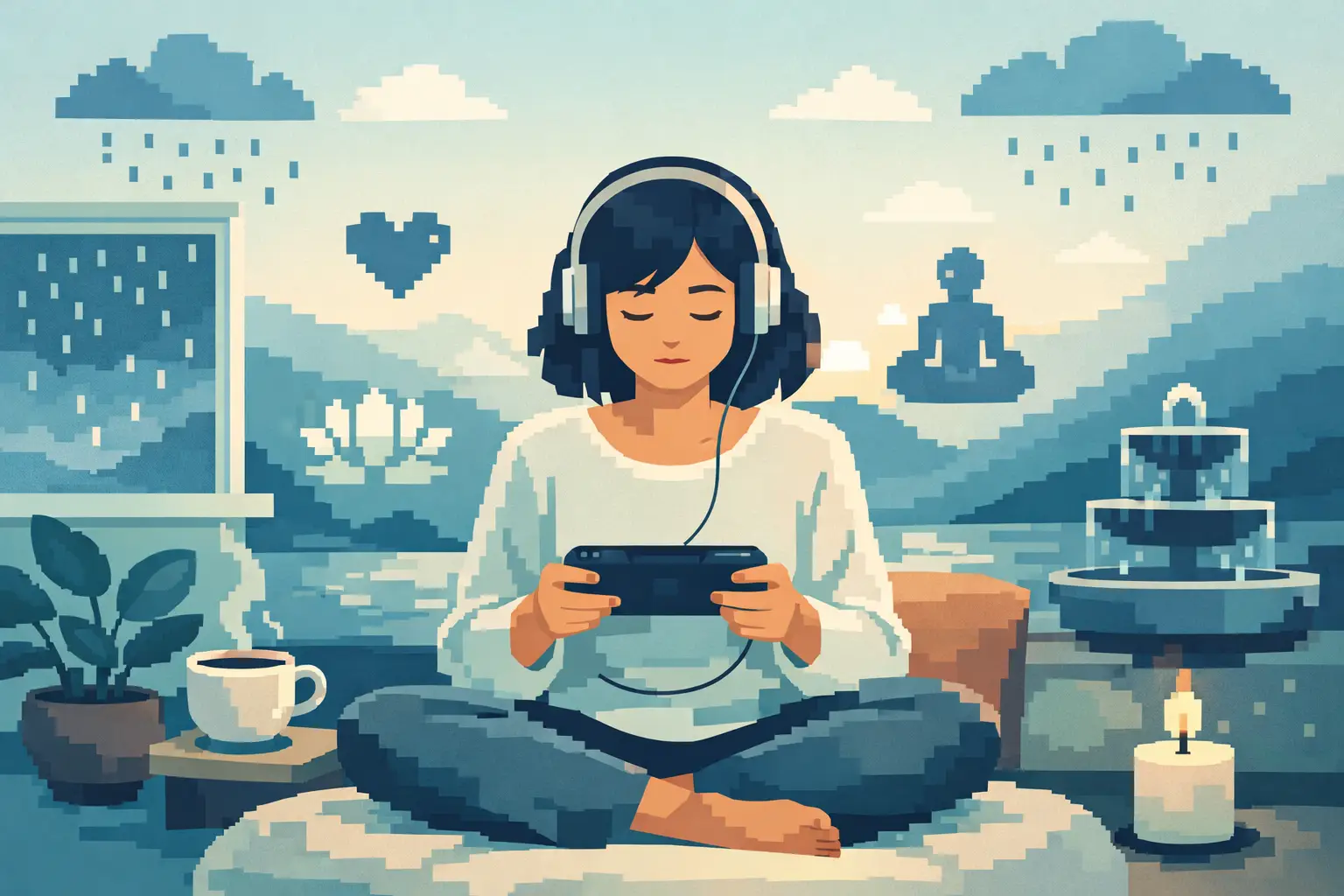
A few quiet minutes can change the shape of an afternoon. The screen does not always need to ask you to react faster, win bigger, or keep up with everyone else. Wellness gaming offers another kind of play: a small visual refuge where satisfying motion, gentle sound, and unhurried progress give your attention somewhere soft to land.
For people who reach for a phone between meetings, while waiting in line, or during an evening wind-down, that difference matters. A game can still feel rewarding without turning a short break into another task. The best relaxing games leave room to breathe.
What wellness gaming is really for
Wellness gaming is not a clinical treatment, and it should not be presented as a replacement for professional mental health support. Its value is simpler and more personal. It creates a low-pressure moment of entertainment that may help you step away from noisy thoughts, daily demands, or the urge to constantly do more.
Unlike competitive games built around rankings, timers, and constant decisions, wellness-focused games tend to make fewer demands on the player. The pace is slower. The goals are clear. There is little penalty for looking away. You can enjoy a satisfying loop for thirty seconds or let it sit beside you while you settle into a calmer rhythm.
That does not mean the experience has to be empty. Progress still matters. Watching a number rise, choosing an upgrade, or returning to a reward collected while you were away gives play a pleasing sense of continuity. The key is that progress supports the mood instead of competing with it.
Why calm visuals make a difference
Visual design can shape how a game feels before you make a single choice. Fast cuts, flashing rewards, crowded menus, and urgent notifications create energy, but they also ask for attention. For a player looking to decompress, a quieter visual language can be more inviting.
Consider the familiar comfort of rain moving down a window. Droplets gather, merge, and slip downward at their own pace. There is motion, but no rush. There is variation, but no confusion. Realistic physics, soft bokeh light, and smooth 60 FPS animation can turn a simple screen into something almost hypnotic to watch.
This is where a sensory experience earns its place in gaming. A peaceful game does not need to overwhelm the player with systems to feel complete. It can offer visual pleasure as a central part of the reward. The act of watching becomes part of the play.
For some people, a bright and lively game is the perfect reset. For others, especially late at night or after a demanding day, high-energy feedback can feel like more stimulation than relief. Wellness gaming works best when it gives players a choice about the kind of attention they want to spend.
Gentle progress still feels satisfying
A relaxing game should not confuse calm with boredom. The small spark of satisfaction that comes from growth is one reason idle games remain so appealing. You make a simple decision, see a result, and return later to find that the world continued moving forward.
In a wellness-focused idle game, upgrades can deepen the experience without making it complicated. A new upgrade might increase the value of each droplet, improve the pace of collection, or reveal another layer of visual richness. These choices offer direction, yet they do not require spreadsheets, perfect timing, or hours of uninterrupted focus.
Offline rewards are especially well suited to this style of play. They respect the player's time by making absence part of the rhythm. Close the app, go about your day, and come back when you feel like it. Your progress has been gently accumulating, rather than waiting for you to perform.
Prestige systems can fit here too, provided they feel like a fresh rainfall rather than a hard reset. Starting a new cycle with a lasting bonus gives long-term players something meaningful to anticipate. The trade-off is balance: if resetting feels punishing or overly technical, it can break the restful mood. The most satisfying prestige mechanics make a new beginning feel light, clear, and worth choosing.
A better fit for real breaks
Many games are designed to hold attention for as long as possible. That can be entertaining, but it is not always what a player needs. A five-minute break can disappear into a string of alerts, limited-time events, and decisions that feel urgent long after the game is closed.
A calmer idle experience treats short sessions as complete sessions. You can open the game, watch a few droplets form and merge, collect your rewards, make one upgrade, and leave feeling finished. There is no need to chase a streak or worry that stepping away means falling behind.
That makes this style of game easy to fit around ordinary moments: the pause before a video call, the quiet seat on a bus, the time between dinner and sleep. It can also work as ambient background play. Sometimes the point is not to actively optimize every second. Sometimes it is enough to watch a soothing pattern unfold.
This lower-demand approach has a practical benefit: it reduces friction. When a game is easy to return to, it can become a dependable small ritual rather than another source of digital clutter. The experience remains available without insisting on itself.
How to choose a wellness game that suits you
The label alone is not a guarantee of a peaceful experience. A game may use soft colors and still lean heavily on ads, countdowns, complicated currencies, or relentless prompts to come back. Look past the first impression and notice how the game treats your time and attention.
A good fit often has an interface you understand quickly, without a long tutorial or crowded screen. Its progression should be visible but forgiving. Its rewards should feel pleasant, not like a warning that you will miss out if you do not check in immediately.
Sound matters, too, though preferences vary. Some players want gentle rain, soft music, or subtle taps. Others want complete quiet. A thoughtful wellness game gives the player control, so the atmosphere can support a reading break, a commute, or a bedtime routine without taking over the room.
It is also worth being honest about what helps you relax. If numerical growth makes you feel compelled to check constantly, a purely ambient experience may be the better choice. If you enjoy a little structure, idle upgrades and passive rewards can give the experience just enough shape. Calm is not one fixed setting. It is the feeling of being able to play on your own terms.
Wellness gaming without the pressure
The strongest wellness games understand that relaxation is not the absence of all mechanics. It is the absence of unnecessary pressure. They pair a clear, satisfying loop with visuals that feel pleasant to return to, then step back and let the player set the pace.
Droplet Idle is built around that idea. Watching realistic droplets collect, merge, and glide across a softly lit screen creates a peaceful visual rhythm, while idle rewards and simple upgrades offer steady progress beneath the surface. It is a game for the moment when you want a little satisfaction without a new demand on your day.
A calm game will not solve every stressful moment, and it does not need to. Sometimes a few minutes of gentle motion, quiet progress, and rain-like light are enough to make the next moment feel easier to meet.