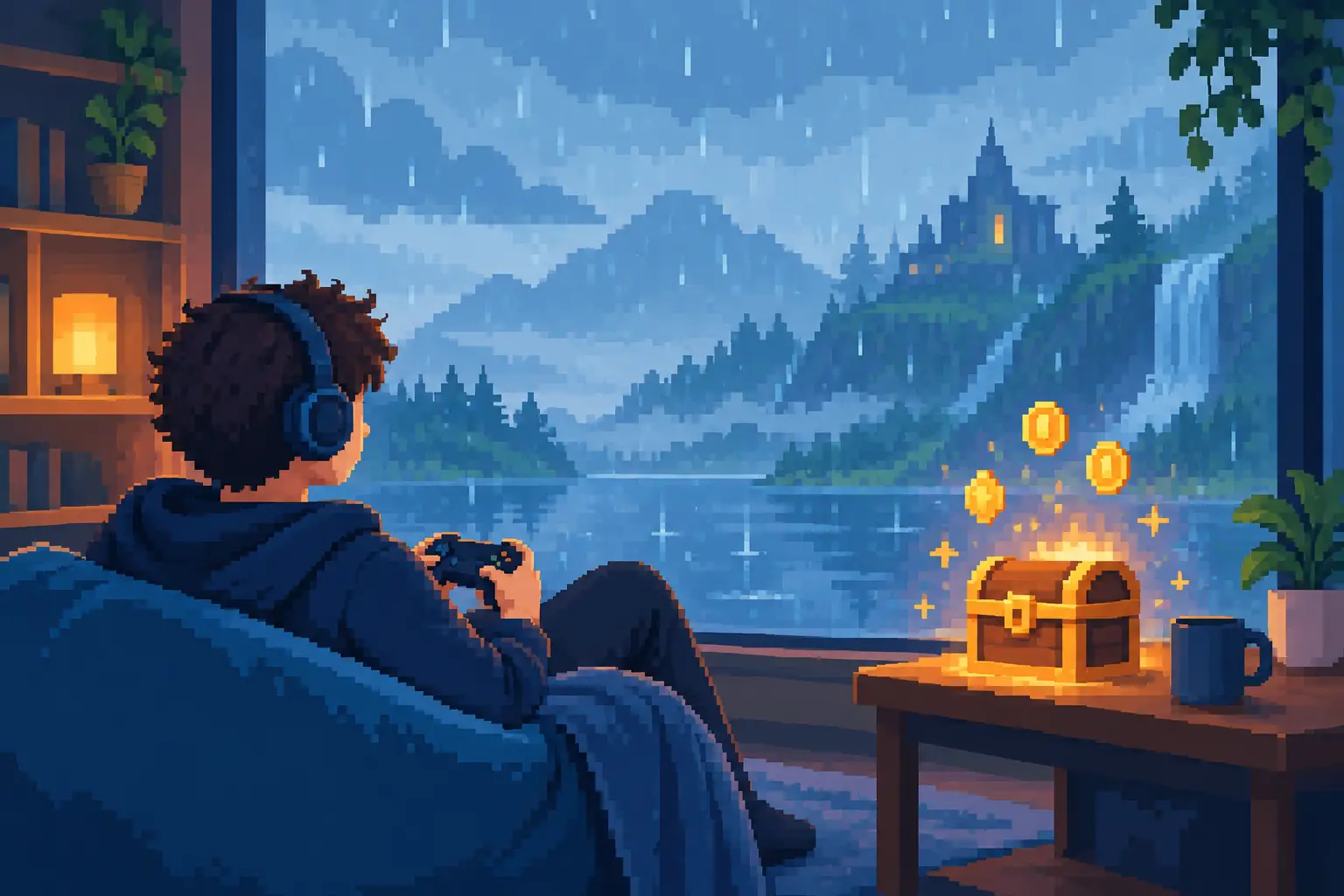
A quiet game can still give you something to look forward to. That is the appeal of games with passive rewards systems: progress continues at a comfortable pace while you make coffee, answer a message, or simply put your phone down for a while. When you return, there is a small, satisfying sense that time has been kind to you.
For players who use games to decompress, that feeling matters. A reward system does not need flashing alerts, impossible timers, or a crowded event calendar to feel worthwhile. Sometimes it is more enjoyable to watch a number gently rise, collect a well-earned bonus, and choose one simple upgrade before returning to the rest of your day.
What Passive Rewards Actually Change
Passive rewards are resources, currency, or progress earned with little or no active input. In an idle game, your production might continue while the app is closed. In a more ambient experience, a visual system may keep evolving at its own soothing rhythm, giving you something pleasant to return to rather than another task to manage.
This changes the relationship between player and game. Instead of asking, “What will I miss if I leave?” the game says, “Come back when you feel like it.” That difference can make a game feel like a small pocket of relief rather than one more demand on your attention.
The best passive systems preserve anticipation without creating anxiety. You may check in after ten minutes and collect a modest reward, or return after a longer break to find enough progress for a meaningful upgrade. Both moments feel useful. Neither asks you to plan your life around a countdown.
Why Calm Progress Feels So Satisfying
Passive progression works because it makes growth visible without making effort feel heavy. There is a gentle rhythm to it: leave, return, collect, improve, and watch the next cycle become a little more rewarding.
That rhythm is especially comforting after a busy day. Competitive games can be exciting, but they often ask for quick reactions, focus, and emotional energy. Games built around passive rewards offer a different kind of satisfaction. The decision-making is lighter, the pace is softer, and the reward arrives without requiring you to perform at your best.
There is also a pleasant sense of continuity. Your game world has not been frozen in place waiting for you. It has been quietly moving forward. This can make even a short return feel meaningful, whether you have thirty seconds between tasks or a few calm minutes before bed.
The reward is not only the currency
In a well-designed idle experience, passive rewards are more than a growing total. They create a moment of visual and emotional payoff. A collection animation, a new upgrade tier, or a more active screen can make progress feel tangible.
For a relaxation-focused game, the atmosphere around that payoff matters just as much as the amount. Soft movement, gentle color, and unhurried feedback can turn a routine collection into a tiny reset for the mind. The goal is not to create a burst of urgency. It is to create a reassuring feeling that something good has accumulated while you were away.
The Difference Between Relaxing and Manipulative Systems
Not every passive reward system is restful. Some games use offline progress as a hook, then surround it with pressure to claim rewards at precise times, watch ads before a bonus expires, or spend currency to avoid falling behind. The mechanic may be passive, but the experience is not.
A calming system respects your time. It lets rewards build at a clear rate, gives you reasonable collection windows, and avoids punishing you for missing a session. You should understand what you are earning and why, without needing a spreadsheet or a daily alarm.
A few details make a real difference:
- Offline earnings should feel generous enough to make returning worthwhile, without making active play feel pointless.
- Upgrades should be easy to understand, so a quick check-in stays relaxing.
- Milestones should offer a pleasant change in pace, not a wall that demands constant grinding.
- Optional boosts should remain optional, never turning a peaceful routine into a chore.
Balance is the quiet craft behind the experience. If rewards arrive too slowly, the game can feel empty. If they arrive too quickly, there is little room for anticipation. The comfortable middle is where each return gives you a choice and a small sense of momentum.
What to Look for in Games With Passive Rewards Systems
If you are choosing a game for short breaks or evening wind-down time, look beyond the word “idle.” Some idle games are built around intense optimization. Others are designed to sit gently beside your day.
Start with the pace. Does the game allow you to make progress in brief sessions, or does it constantly pull you back for limited-time tasks? A relaxed game should fit around your schedule, not compete with it. You should be able to close it without worrying that you have made a mistake.
Then consider what you will be looking at. Passive play is naturally repetitive, so the visuals and sound need to remain pleasant over time. A clean interface, soft animation, and a satisfying central motion can make familiar actions feel restorative instead of monotonous.
Finally, consider the kind of progress on offer. Numbers alone can be motivating, but the most memorable games pair upgrades with a visible shift in the experience. More movement on screen, a new visual layer, or a fresh rhythm gives growth a sense of texture. It helps the game feel alive without becoming loud.
A More Gentle Kind of Idle Game
Droplet Idle approaches passive play through the familiar comfort of rain on a window. Realistic water droplets form, merge, and slide across the screen in a soothing rhythm, while simple progression gives each return a little more to enjoy. The visual experience stays at the center, with rewards and upgrades supporting the calm rather than interrupting it.
This is a useful direction for the genre. Idle games do not have to be full of factories, battle timers, and endless dashboards. Progress can be quiet. It can be built around the pleasure of watching something beautiful change slowly, then returning to find that your patience has been rewarded.
For some players, that may mean checking in for a minute during a work break. For others, it may mean leaving the game open while winding down at night. There is no single right way to play when the system is designed to meet you where you are.
Passive Rewards Work Best When You Stay in Control
The healthiest relationship with a game is one where you choose the moment of return. Passive rewards support that choice by removing the feeling that every second away is lost progress. They allow the game to become a companion to quiet moments, not a source of interruption.
Of course, preferences vary. Some players enjoy maximizing every multiplier and planning their next prestige reset. Others want almost no decisions at all. A thoughtful passive system can welcome both styles by keeping the core loop clear: collect what has grown, choose whether to improve it, and enjoy the result.
That simplicity has lasting value. When a game gives you a beautiful screen, a gentle pace, and progress that waits patiently for your return, even a small check-in can feel like a breath of fresh air. Let the rewards gather, come back when the moment feels right, and keep play in its most peaceful place: on your own time.