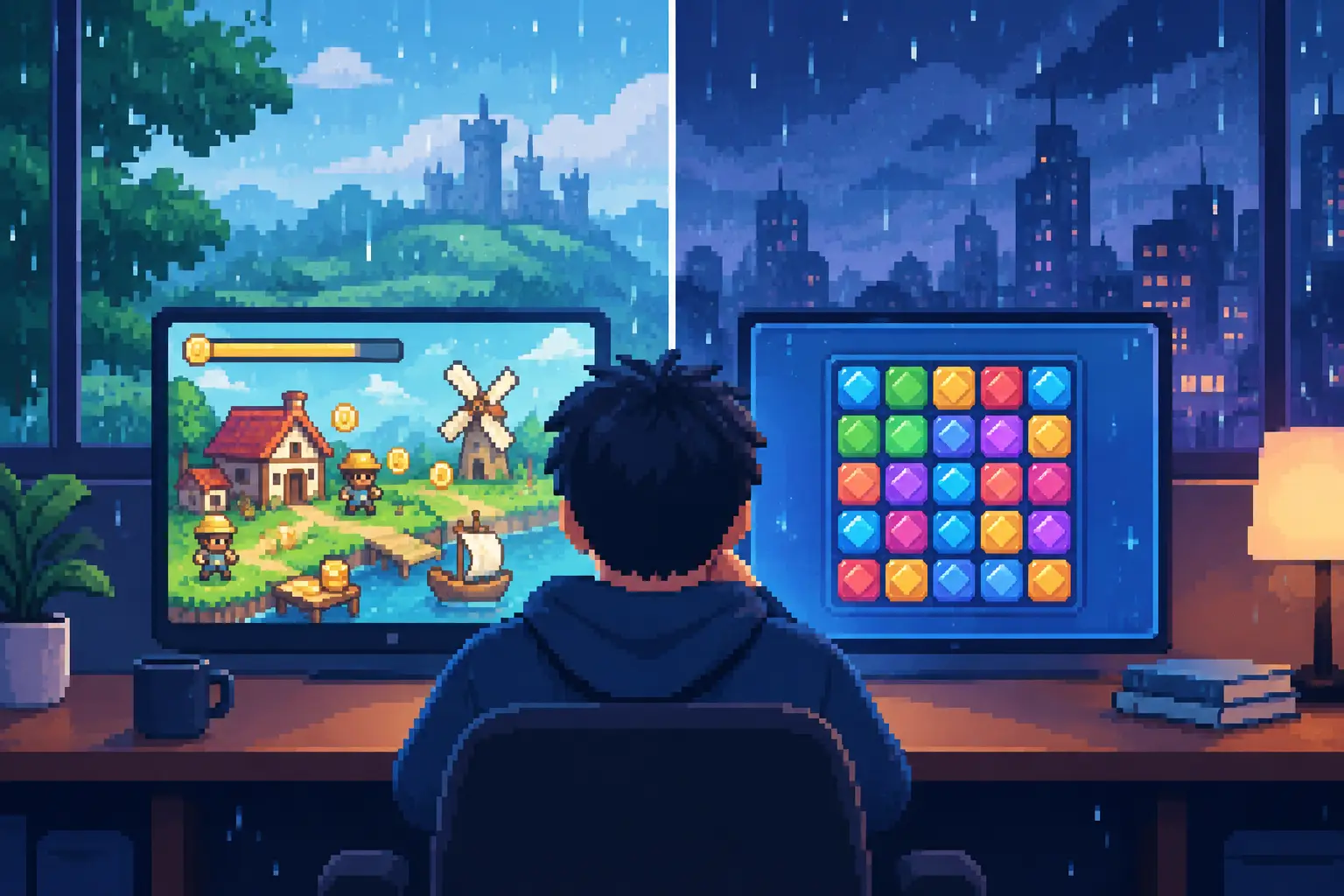
A five-minute break can ask very different things from a game. One game may hand you a grid, a timer, and a problem to solve. Another may let soft motion unfold while your progress quietly grows. When considering idle games versus puzzle games, the better choice is less about which genre is smarter or more rewarding and more about what you need from the moment.
For some players, a puzzle is the perfect mental reset. For others, the last thing a busy day needs is another challenge waiting for the right answer. Both genres can be deeply satisfying, but they create that satisfaction through very different rhythms.
Idle Games Versus Puzzle Games: The Core Difference
Puzzle games place the player at the center of each outcome. You notice patterns, make decisions, test an idea, and see whether it works. A match lands, a word appears, a route opens, or a difficult level finally gives way. The pleasure comes from attention and resolution.
Idle games are built around a gentler loop. Progress continues through simple actions, upgrades, milestones, and often offline rewards. You still make choices, especially when deciding what to improve or when to reset for a larger boost, but the game does not demand constant input. It creates room to watch, return, and enjoy the slow accumulation of something satisfying.
Neither approach is automatically more relaxing. A familiar puzzle game can feel comforting, while an idle game with dense menus and aggressive goals can feel like work. The real difference is where the effort sits. Puzzle games usually ask for focused thought now. Idle games tend to reward patience over time.
When a Puzzle Game Feels Right
A puzzle game is often a good fit when you want your attention fully occupied. A well-designed level can pull your mind away from a repetitive commute, an awkward wait, or a wandering train of thought. The clear objective can be reassuring: there is a problem in front of you, and there is a way through it.
That active focus is also why puzzles can feel so satisfying. Each success is personal. You saw the connection, planned the move, or stayed with the challenge until the answer became clear. For players who enjoy measurable skill growth, this direct relationship between effort and result is hard to beat.
The trade-off is mental energy. Even casual puzzles can create friction when you are tired, distracted, or short on time. A level that is pleasantly challenging at lunch may feel irritating late at night. Timers, limited moves, streaks, and difficult stages can add pressure, especially when the game makes a loss feel costly.
Puzzle games are best when you want a small, contained activity. They give your brain something to hold onto. If that sounds restorative rather than demanding, they can turn a short break into a genuinely rewarding one.
Why Idle Games Feel Different After a Long Day
Idle games offer a softer kind of satisfaction. Instead of asking you to overcome a new obstacle every few minutes, they let you settle into a rhythm of small rewards. Numbers rise, resources collect, an upgrade improves the next cycle, and the world on screen becomes more abundant over time.
That pace makes idle games especially appealing when your attention is already spoken for. You can check in during a quiet coffee break, let the game sit beside a podcast, or spend a few relaxed moments deciding on your next upgrade. There is structure without the feeling that you must perform.
The best idle experiences also make waiting enjoyable. Visual movement matters here. Watching droplets gather, merge, and glide down a glass-like surface can be as rewarding as the currency earned along the way. In a game such as Droplet Idle, the progression loop is paired with realistic water motion and dreamy light, giving the eye something soothing to return to while passive rewards build.
This does not mean idle games have no depth. Prestige systems, upgrade paths, collection goals, and long-term milestones can give players plenty to consider. The difference is that these systems can be approached at your own pace. You are invited to optimize, not forced to react.
Focused Satisfaction or Gentle Progress?
The simplest way to choose between the genres is to notice the kind of satisfaction you are looking for. Puzzle games deliver a sharp sense of completion. You finish the level, solve the pattern, and experience a clean little spark of victory. Idle games deliver continuity. You return later and find that your small earlier choice has continued to matter.
A puzzle game is often about the pleasure of getting unstuck. An idle game is often about the pleasure of seeing something grow.
This distinction matters more than it may seem. If your day is full of decisions, deadlines, or conversations, another game that asks for precision may not be the escape you want. A passive progression loop can feel lighter because it leaves room for thought, rest, or simply looking at something beautiful.
On the other hand, if you are feeling restless or under-stimulated, an idle game may be too quiet. In that moment, a clever puzzle can provide the satisfying resistance you are missing. The right game can change from one evening to the next.
Time Commitment Changes the Experience
Puzzle games often work beautifully in a deliberate ten- or twenty-minute session. You open the app, work through a few levels, and leave with a clear stopping point. Some levels are quick, but others invite the familiar thought: just one more try.
Idle games are more flexible around uneven schedules. A brief check can be enough to collect earnings, choose an upgrade, and enjoy a moment of motion. Because progress may continue while you are away, stepping out of the game does not feel like abandoning it. That makes the genre especially friendly for people who play in fragments rather than long sessions.
There is a trade-off here, too. Players who love immediate, skill-based feedback may find passive progress less exciting than a solved puzzle. Meanwhile, players who dislike being blocked by a hard stage may appreciate that idle games rarely turn a single difficult moment into a wall.
The Role of Stress and Pressure
Not every puzzle game is stressful, and not every idle game is calm. Design choices matter. A serene puzzle with no timer can be a lovely wind-down ritual. An idle game crowded with pop-ups, competitive rankings, and constant limited-time demands can lose its sense of ease.
Still, the genres begin with different expectations. Puzzles usually create tension on purpose. There is a challenge, a constraint, and a moment where your next move matters. Idle games usually soften tension by making progress resilient. Even when you do nothing for a while, something is still gently moving forward.
For relaxation-focused players, that resilience is powerful. It removes the feeling that every session must be productive. You can enjoy a small upgrade, watch an animation for a minute, and put the phone down without losing your place in the experience.
Choose the Game That Matches Your Energy
If you want a game that engages your mind, gives you a clear objective, and rewards a clever solution, puzzle games are likely to feel satisfying. They are wonderful companions for moments when you want to be present, alert, and pleasantly challenged.
If you want visual comfort, low-pressure progress, and a stress-free experience that fits around your life, idle games may be the better match. They offer a quieter form of reward: not the rush of a perfect answer, but the calm pleasure of watching small things become more.
There is no need to pick one genre forever. A puzzle may be exactly right for a bright afternoon when you want a little mental spark. Later, when the room is dimmer and the day feels full, a slow stream of progress and mesmerizing motion may be the kinder choice. Let your energy decide, then give yourself permission to play in the way that feels good.