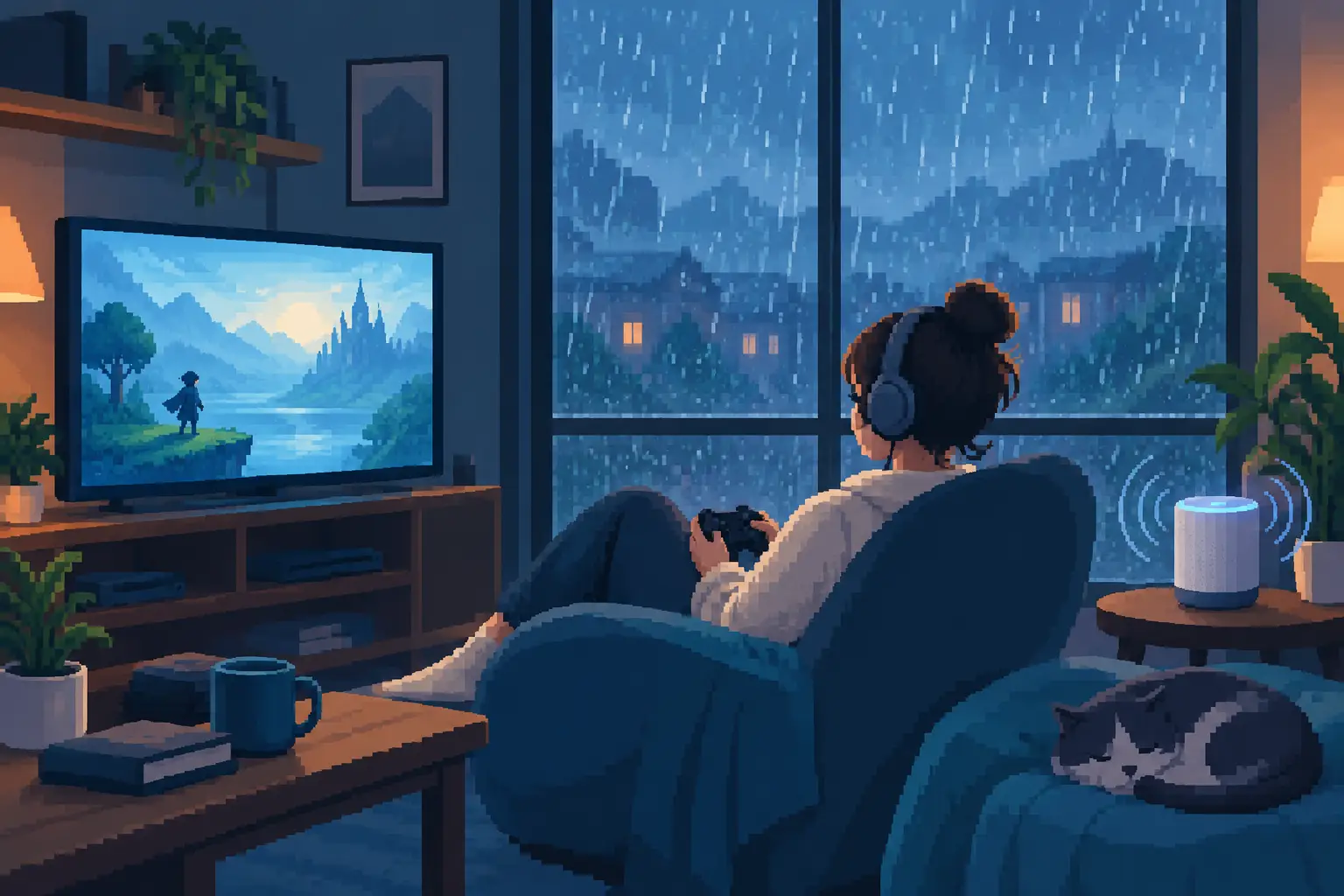
A rain track can soften the edges of a busy evening. But for some people, it leaves the mind with a little too much empty space. That is where rainy games versus white noise becomes a more interesting choice than it first appears. Both can create a calmer atmosphere, yet they offer different kinds of rest: one asks nothing of you, while the other gives your attention somewhere gentle to land.
White noise is wonderfully simple. Press play, put down the phone, and let a steady wash of sound cover distracting conversations, traffic, or the lingering mental replay of the day. Rainy games add a quiet layer of visual comfort and light interaction. They can turn the familiar feeling of rain on a window into a small, satisfying ritual.
Why White Noise Feels So Restful
White noise, rain sounds, fan sounds, and other ambient recordings work by creating a consistent audio backdrop. Their predictability is part of the appeal. There is no plot to follow, no task to finish, and no sudden demand for a response. For sleep, reading, focused work, or a moment when screens feel like too much, that absence of stimulation can be exactly right.
It can also help make an inconsistent environment feel less intrusive. A neighbor's door closing or a car passing outside may stand out sharply in a quiet room. A soft, continuous soundscape makes those changes feel less prominent. The result is not silence, but a smoother sonic space.
The trade-off is that sound alone does not always hold attention. If you are restless, anxious, or stuck in a loop of thoughts, passive audio may become background noise in the most literal sense. Your mind can continue racing right over it. That does not mean white noise has failed. It simply means you may need a calming focal point as well as a calming soundtrack.
Rainy Games Versus White Noise: The Key Difference
The clearest difference is participation. White noise is designed to fade into the background. A rainy game can stay softly in the foreground without becoming demanding.
A well-made relaxing game gives your eyes a soothing rhythm to follow: droplets gathering, merging, and slowly sliding down glass; soft bokeh lights glowing behind a rain-streaked window; small changes that happen at an unhurried pace. These repeating movements are more engaging than a static image, but far less intense than fast action, competitive matches, or games filled with alerts.
That visual motion matters because attention often needs a place to settle. Watching water behave naturally can offer a low-pressure alternative to scrolling social feeds, where every swipe introduces another headline, opinion, or decision. Instead of feeding overstimulation, the screen presents one cohesive, peaceful scene.
There is also a satisfying distinction between distraction and gentle engagement. Distraction pulls you away from discomfort by asking for a lot of focus. Gentle engagement gives the mind a small, pleasant task without making it work hard. In a rainy idle game, that might mean collecting passive rewards, choosing an upgrade, or checking on progress after a few minutes away. The action is light, but it gives the moment shape.
When White Noise Is the Better Choice
White noise is often best when you genuinely want to disengage. If you are trying to sleep, recover from a headache, meditate without looking at a screen, or make a busy environment less distracting, audio can be the cleaner option. Its strength is that it does not invite you to do anything.
It is also useful when visual stimulation would work against your goal. Bright screens late at night can be counterproductive for some people, even when the content itself is calm. In that case, a dark room and a rain recording may be more restorative than any app.
Choose white noise when you want your surroundings to feel quieter, your thoughts to have less competition, and your device to disappear from the experience. It is a background companion, not an activity.
When a Rainy Game Feels Better
A rainy game is often the more satisfying option when you need to decompress but are not ready to sit completely still. Maybe you have just finished work and your mind is still moving quickly. Maybe you want a few minutes away from messages and social media, but a pure soundscape feels too passive. Maybe you enjoy idle games but are tired of timers, pressure, and endless optimization.
This is where the combination of ambient visuals and simple progression can feel especially comforting. The visual scene provides immediate relief. The progression system provides a small sense of momentum. You can enjoy the quiet pleasure of watching something grow without being pulled into an intense objective.
Droplet Idle is built around this balance. Realistic droplets form, merge, and glide across the screen at 60 FPS, creating the familiar visual comfort of rain against glass. Beneath that peaceful surface, upgrades, offline rewards, and prestige mechanics offer a rewarding reason to return. The experience remains stress-free because progress does not require constant attention.
That balance matters. Some games use relaxing artwork but still rely on urgent events, competitive rankings, or complicated daily checklists. Others offer idle progression but fill every moment with pop-ups and currencies to manage. A truly calming rainy game should let the atmosphere lead. Its mechanics should support the soothing rhythm, not interrupt it.
The Best Choice Depends on Your Moment
There is no universal winner between rainy games and white noise because the best choice changes with your energy level. Think of white noise as a quiet room with the lights low. Think of a rainy game as sitting by the window with something beautiful to watch and a small, pleasant activity in your hands.
If your attention feels overloaded, start with white noise. Let the steady sound reduce the sharpness of the day. If your attention feels scattered, try a rainy game. The slow movement and simple goals may help gather your focus without demanding much in return.
Many people will find that the two work well together. A gentle rain soundtrack paired with dimmed-screen visuals can make a short break feel more intentional. The key is to avoid turning relaxation into another item to optimize. There is no need to measure how calm you become or force yourself into a routine that does not fit.
What to Look for in a Calming Digital Escape
Not every rain-themed app creates the same feeling. The details make a difference. Visuals should move smoothly rather than flash for attention. Sound should be easy to adjust or mute. Notifications should be optional, not insistent. Most of all, the experience should leave room for you to pause without guilt.
For a game, the progression loop should feel like a soft reward, not a chore. It is satisfying to return and see that passive progress has accumulated. It is less relaxing when missing a session means falling behind. Look for a pace that respects short breaks, quiet evenings, and the simple pleasure of doing very little.
For white noise, choose a sound that feels natural rather than overly repetitive or harsh. Rain can be soothing, but the right texture varies from person to person. A light drizzle may work for reading, while a deeper storm ambience may feel better when you want to block out a noisy apartment or settle down for sleep.
The most helpful option is the one that makes your next few minutes feel lighter. If you need stillness, let soft rain sounds fill the room. If you need a calm point of focus, let a window of slowly moving droplets hold your attention for a while.