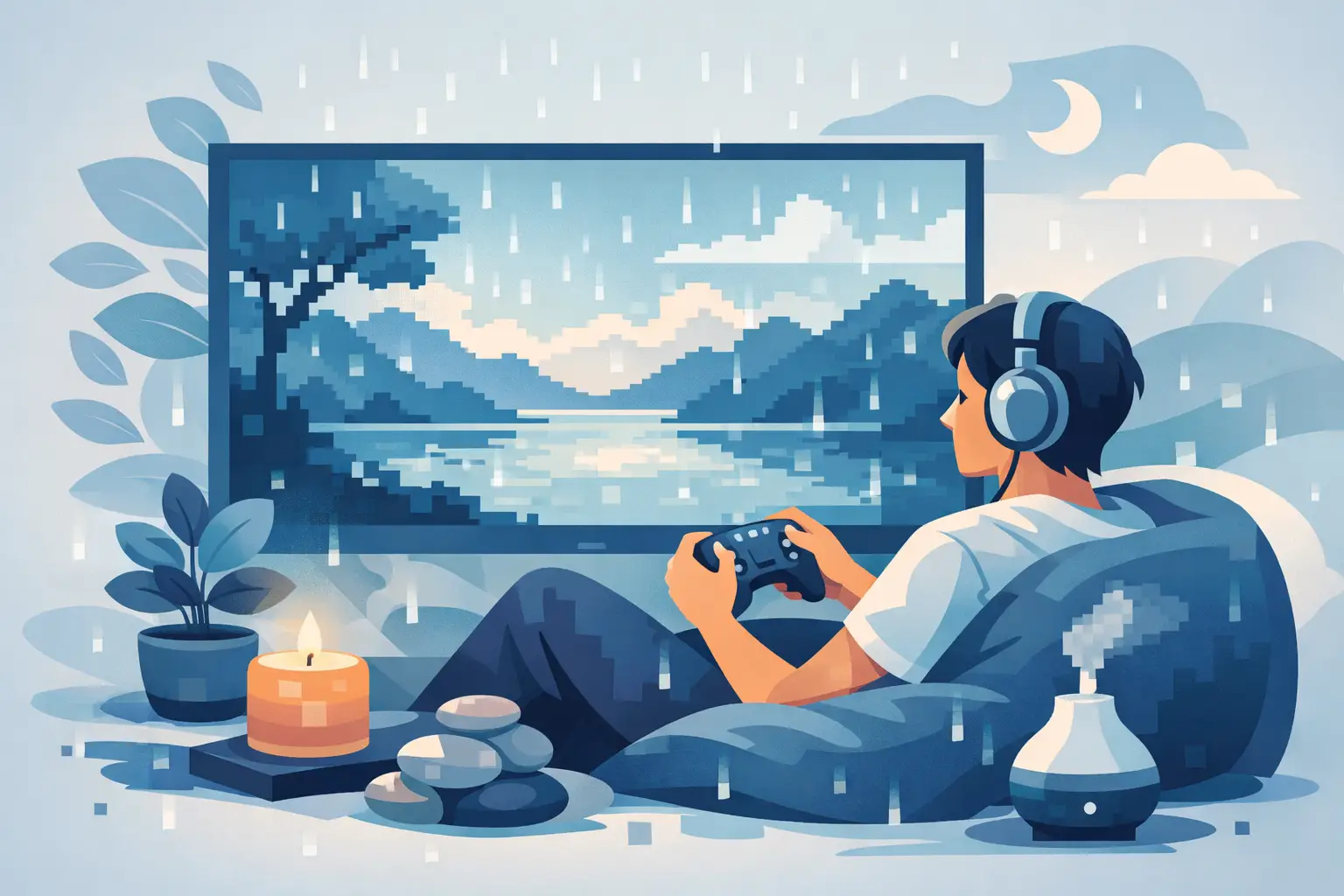
A quiet game can feel very different from a loud one. Instead of reacting to timers, alerts, opponents, and flashing rewards, you might spend a few minutes watching raindrops gather on a window, merge, and slowly find their way down the glass. Can games help sensory relaxation? For many people, the right kind of play can create a small pocket of calm - not by demanding attention, but by giving the senses something gentle and satisfying to rest on.
That does not mean every game is relaxing, or that a game can replace sleep, therapy, or care for ongoing stress. It means play can be part of a personal wind-down routine when its visuals, sounds, pace, and goals fit what your mind needs in that moment.
Can Games Help Sensory Relaxation?
Sensory relaxation is the experience of reducing unnecessary input and settling into sensations that feel predictable, pleasant, and manageable. Think of soft rain, warm lighting, a familiar song played quietly, or the steady motion of waves. A game can offer a similar experience when it is designed around rhythm rather than urgency.
Gentle games often work because they give the brain a simple focal point. There is enough happening to interrupt a stressful thought spiral, but not so much that you need to stay on alert. Watching an animation repeat, making a small upgrade, or collecting an offline reward can offer a reassuring sense of movement without the pressure of high-stakes decisions.
The key is not whether something is technically a game. The key is how it feels to use. A countdown timer, competitive ranking, surprise attack, or barrage of notifications may be energizing for one player and draining for another. Slow, visually coherent play is more likely to support a restful mood when it leaves room to breathe.
Why Gentle Gameplay Can Feel So Settling
A calming game usually brings a few sensory elements together. It uses visuals that are pleasing without being overwhelming, movement that follows an understandable pattern, and goals that feel available rather than urgent. When those pieces align, the experience can become a soft transition between a busy day and a quieter evening.
Predictable motion gives the eyes a place to rest
Fluid motion can be deeply satisfying when it has a natural rhythm. Water droplets forming, joining, and sliding across a surface create tiny moments of anticipation and release. Your eyes can follow the movement without having to scan for danger, memorize a map, or react at speed.
This is one reason ambient animation matters. A still screen may not be engaging enough to hold attention, while constant visual effects can become tiring. The middle ground is motion with an easy-to-read pattern: a drifting particle, a growing garden, clouds moving overhead, or droplets responding to gravity.
Small rewards can feel better than big demands
Progression is not automatically stressful. In fact, a clear, low-pressure reward loop can add comfort to a relaxing experience. A number rises, a visual changes, or a new upgrade becomes available. You receive a small sense of completion without needing to perform perfectly.
Idle games are especially suited to this balance. They can keep moving while you take a break, and they welcome you back with progress rather than punishment. The most relaxing version of that loop avoids making players feel guilty for stepping away. Offline rewards, gentle upgrades, and optional prestige systems can make return visits feel like opening a small gift rather than catching up on missed work.
Familiarity lowers the effort of choosing
At the end of a demanding day, even deciding what to do can feel like another task. A familiar game reduces that friction. You know where to tap, what the next step means, and how long a session can last. There is comfort in a world that does not ask you to learn a new system every time you open it.
That is why simple does not have to mean empty. A game can have meaningful long-term progress while keeping each individual moment easy to understand. The calm comes from clarity, not from a lack of depth.
The Trade-Off: Not Every Calm-Looking Game Is Calming
Soft colors and peaceful music alone do not guarantee a relaxing experience. Some games pair cozy visuals with energy systems, daily streaks, limited events, pop-ups, or constant pressure to optimize. If you finish a session feeling behind, rushed, or tempted to keep checking, the design may be working against your goal.
It also depends on your sensory preferences. A rain sound may soothe one person and irritate another. Sparkling effects might feel dreamy at low intensity but become too bright in a dark room. Even a satisfying tap sound can be distracting when you are already overstimulated.
Pay attention to the feeling after five or ten minutes. Do your shoulders loosen? Is your breathing easier? Could you put the game down without resistance? Those signals matter more than a game label promising relaxation.
A few design choices tend to make a real difference:
- Adjustable sound lets you keep soft ambience while muting sharper effects.
- Reduced motion or gentle animation settings can help when fast movement feels tiring.
- Minimal notifications protect the break from becoming another source of interruption.
- Sessions without penalties make it easier to play for enjoyment, then leave when you are ready.
The best option is personal. For some players, sensory relaxation means complete silence and a dim screen. For others, it means a soft visual loop with rainfall in the background. There is no single correct way to unwind.
How to Use a Game as Part of a Wind-Down Routine
A relaxing game works best when it has a clear role. Rather than opening it automatically whenever there is a spare second, try using it as a transition. Play for a few minutes after closing work apps, while waiting for tea to steep, or before switching off the lights for the evening.
Set the environment up for calm, too. Lower screen brightness, turn down haptics if they feel abrupt, and use headphones only if they make the experience more comfortable. If sound feels like one more layer of input, let the visuals do the work. A realistic water animation can still provide a soothing rhythm in silence.
It can help to choose a gentle stopping point. Maybe you collect your idle rewards, purchase one upgrade, and watch the scene for another minute. A natural finish keeps the game from expanding into a late-night session that leaves you more awake than before.
Droplet Idle is built around this quieter kind of return: realistic droplets, dreamy bokeh lighting, smooth 60 FPS motion, and light idle progression that can be enjoyed without a competitive pull. The appeal is not about chasing a perfect run. It is about taking a brief pause with a screen that feels more like rain on a window than a demand for your attention.
Choose a Game That Matches Your Current Energy
The game that feels relaxing at 3 p.m. may not be the right one at 11 p.m. When you are bored and restless, a little more interaction can be welcome. When you are mentally full, even a simple puzzle may ask too much. Match the experience to your available energy instead of forcing yourself through a style of play that no longer feels good.
For low-energy moments, look for slow pacing, simple controls, forgiving progress, and visuals you would be happy to watch without touching the screen. For a short mental reset during the day, a gentle task or modest upgrade loop may provide just enough focus to interrupt distraction. If you want comfort rather than accomplishment, ambient games are often the better fit.
Avoid treating relaxation as another metric to optimize. You do not need to earn the perfect calm session or keep a streak alive. If a game feels nourishing one night and uninteresting the next, that is useful information. Close it, stretch, sit in quiet, or choose something else.
When to Put the Screen Down Instead
Games can support sensory relaxation, but they are not always the answer. If the screen brightness is bothering your eyes, if you feel unable to stop scrolling between apps, or if the game is making you more alert, a screen-free pause may be kinder. Dim light, water, a short walk, or simply resting without input can offer what a game cannot in that moment.
And if stress, anxiety, sleep difficulty, or sensory overwhelm feels persistent or hard to manage, professional support can be an important next step. Calm play is a comfort tool, not a promise to solve everything.
The most useful relaxing game is the one that asks very little and leaves you feeling a little more like yourself. Let the animation slow down the moment, let progress arrive at its own pace, and give yourself permission to stop when the quiet has done its job.